Study sounds that hold your attention instead of stealing it
The right study sound isn’t entertainment — it’s insulation. Its job is to mask the unpredictable noises around you (doors, traffic, other people’s conversations) with something steady enough that your brain stops listening altogether. That’s why rain works and your favourite playlist often doesn’t: lyrics and hooks ask for attention; weather never does.
What’s in the mixer
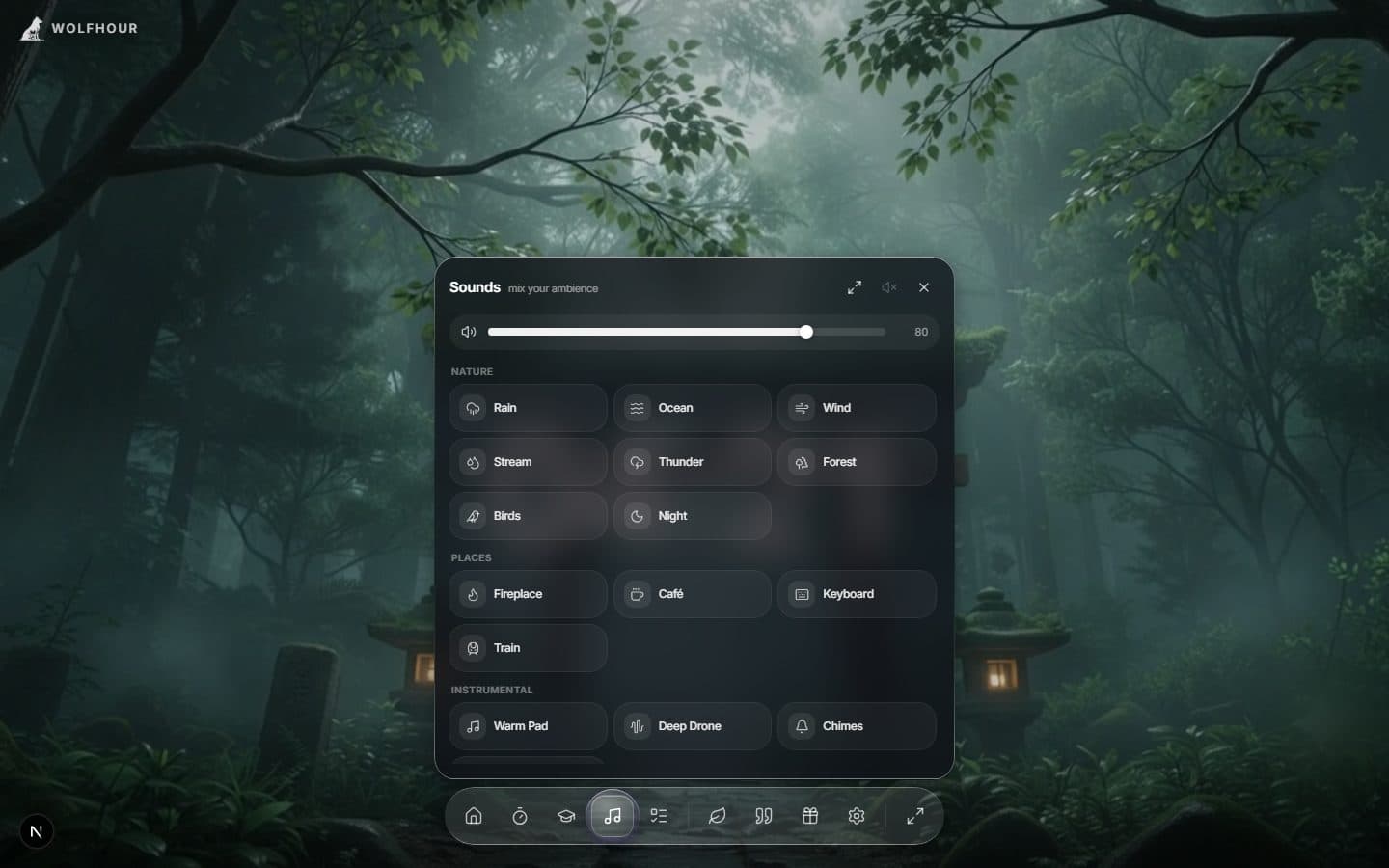
Wolfhour ships 22 sounds across five groups — Nature (rain, ocean, wind, stream, thunder, forest, birds, night), Places (fireplace, café, keyboard, train), Instrumental (warm pad, deep drone, chimes, dream piano), Lo-Fi (vinyl, tape hiss, lo-fi keys) and Noise (white, pink, brown). Nearly all are synthesised live in your browser rather than played from a looped file — so there’s no loop seam to catch your ear at minute nine, and no audio files to download before focus starts.
Which study sounds actually work, and when?
- Rain & storms — broad-spectrum, irregular but patternless. The safest default for reading and writing.
- Waves — slower rhythm, good for long revision sessions where you want calm more than drive.
- Café & room tone— a low murmur of activity that recreates the “working alongside others” effect; many people focus better with mild social hum than in silence.
- Fire & night ambience — best for winding down or low-pressure review, when a harsher soundscape would feel like pressure.
White, pink, or brown noise — which one?
The noise colours differ in where their energy sits. White noise spreads evenly across all frequencies — bright, hissy, the strongest masker for sharp interruptions like clattering keyboards or voices through a wall. Pink noise tilts toward the low end — softer, closer to steady rainfall, the easiest to leave on for hours. Brown noisegoes lower still — a deep rumble like distant surf or a plane cabin, which many people find the most physically calming. There’s no winner; there’s a match for your room and your ears. Wolfhour ships all three, so the cheap experiment is to try each for one study block and keep whichever one you stopped noticing first — disappearing is the job.
Layering: the difference between a sound and a place
A single loop can turn repetitive. Layering fixes that: rain as the base, distant thunder for depth, a faint fire crackle for warmth. Wolfhour’s mixer lets you stack sounds with independent volumes and save the blend — your own room, rebuilt in ten seconds, on any device. The scene behind the clock moves with it, so the whole screen agrees about where you are.
Match the sound to a scene
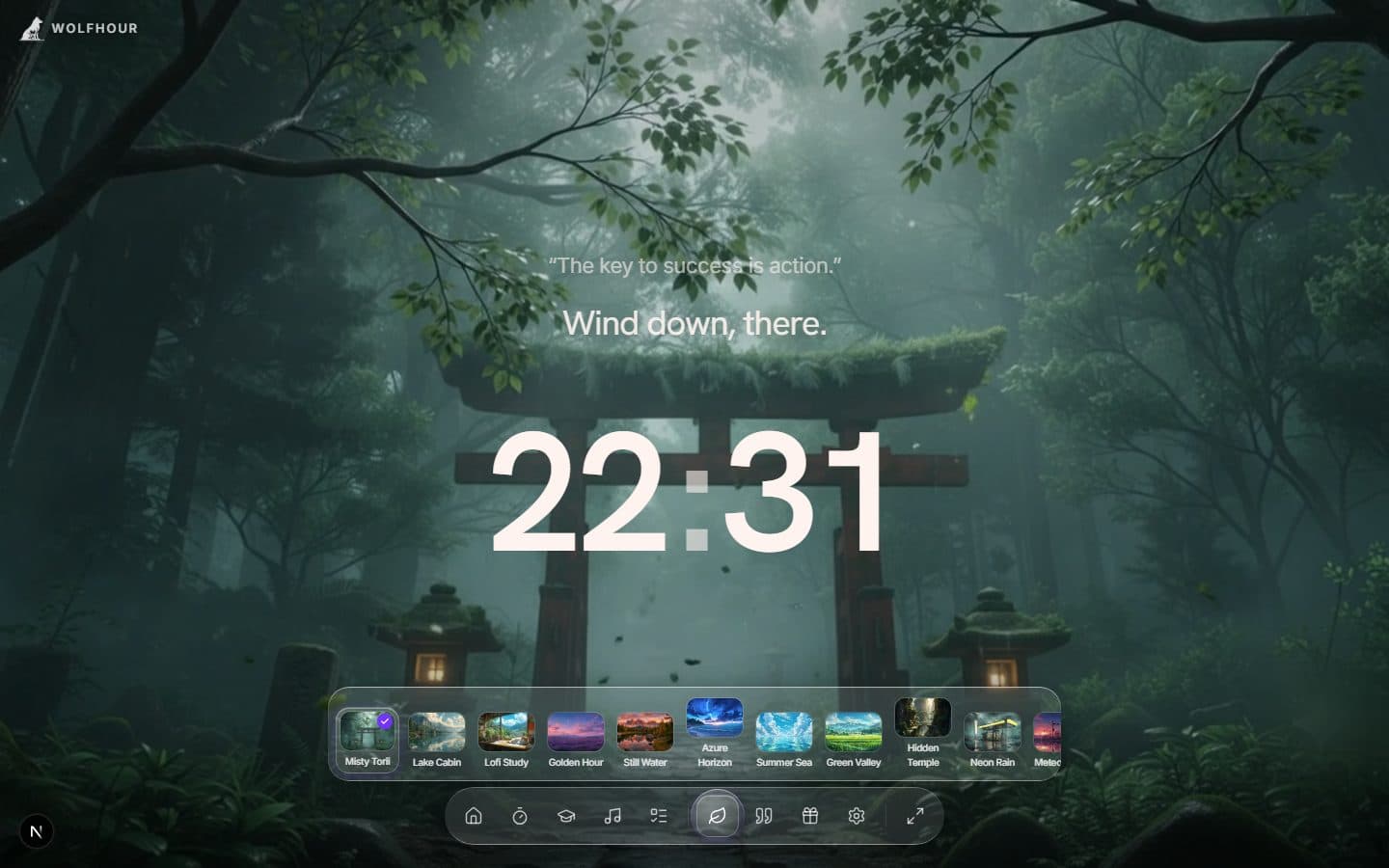
Sound is half the room; the picture is the other half. Wolfhour pairs your mix with eleven live cinematic scenes — a misty shrine for rain, a lake cabin for waves, neon rain for late-night lo-fi. Pick once and both halves persist together, so opening the app drops you straight back into your place.
Using sound as a start cue
Keep one mix for work and only for work. Press play, and after a week or two the sound itself starts your session — the same way a gym playlist gets you lifting. Pair the mix with a pomodoro blockand the beginning of focus stops being a decision at all. If you’re tracking serious study hours across subjects, run your mixes inside Aspirant mode so every session lands in your stats.
Practical notes
- Keep volume just above room noise — masking, not blasting.
- Wolfhour works offline once installed as an app, so your mix survives a dead connection.
- All sounds are royalty-free and included in the free experience.
Study sound questions, answered
Is ambient sound better than music for studying?
For most reading and writing, yes. Lyrics and melodies compete for the language and pattern circuits you're trying to study with; steady ambience masks distractions without asking for attention. Save the playlist for mechanical tasks like copying notes.
How loud should study sounds be?
Just above the noise you're trying to mask, and no louder. If you notice the sound itself, turn it down — the goal is for your brain to stop listening entirely.
Do I need headphones?
No, speakers work fine in a quiet room. Headphones help in shared spaces — a library, a hostel, a family living room — where the noise you're masking is close by.
Are Wolfhour's sounds free?
Yes — all 22 sounds, the mixer, and every scene are free, with no signup needed to start. Nearly all sounds are synthesised live in your browser, so nothing downloads and nothing loops.